
POWER Magazine: Former SpaceX engineer drives Arbor’s turbine innovation
Demand for electricity from artificial intelligence (AI), data centers, industrial electrification and more is driving innovation in the power generation sector. Speed to power has become even more important, as companies seek ways to more quickly satisfy their hunger for power, without sacrificing efficiency and in some cases their clean energy goals.
Ensuring a supply of firm, deployable power, within ever-tighter timelines, has highlighted issues with equipment supply chains, particularly for gas turbines. The backlog of orders is large; delivery timelines no longer are measured in months, but in years. New turbine manufacturers are entering the market, with technologies designed for faster availability, and in scalable configurations to enable flexibility.
One of those companies is Arbor Energy, headquartered in El Segundo, California. The company, founded in 2022, has designed a modular, scalable power station that generates baseload electricity with zero operating emissions. The company said the core of its product “is a supercritical CO2 turbine system powered by advanced oxy-combustion.”
The group said its HALCYON technology is fuel-flexible by design, capable of running on fuels from natural gas to syngas. Arbor’s 25-MW turbines are designed to deliver firm power on shorter timelines than traditional large-frame units. The modular design enables gigawatt-scale deployment at a single site for large loads, such as data centers, or smaller installations for industrial power and grid firming.
Arbor’s system, using advanced manufacturing and a compact rocket engine-inspired powertrain, avoids the supply chain bottleneck of blades and vanes used by legacy original equipment manufacturers, which the company said is currently driving five-plus-year backlogs for traditional turbines.
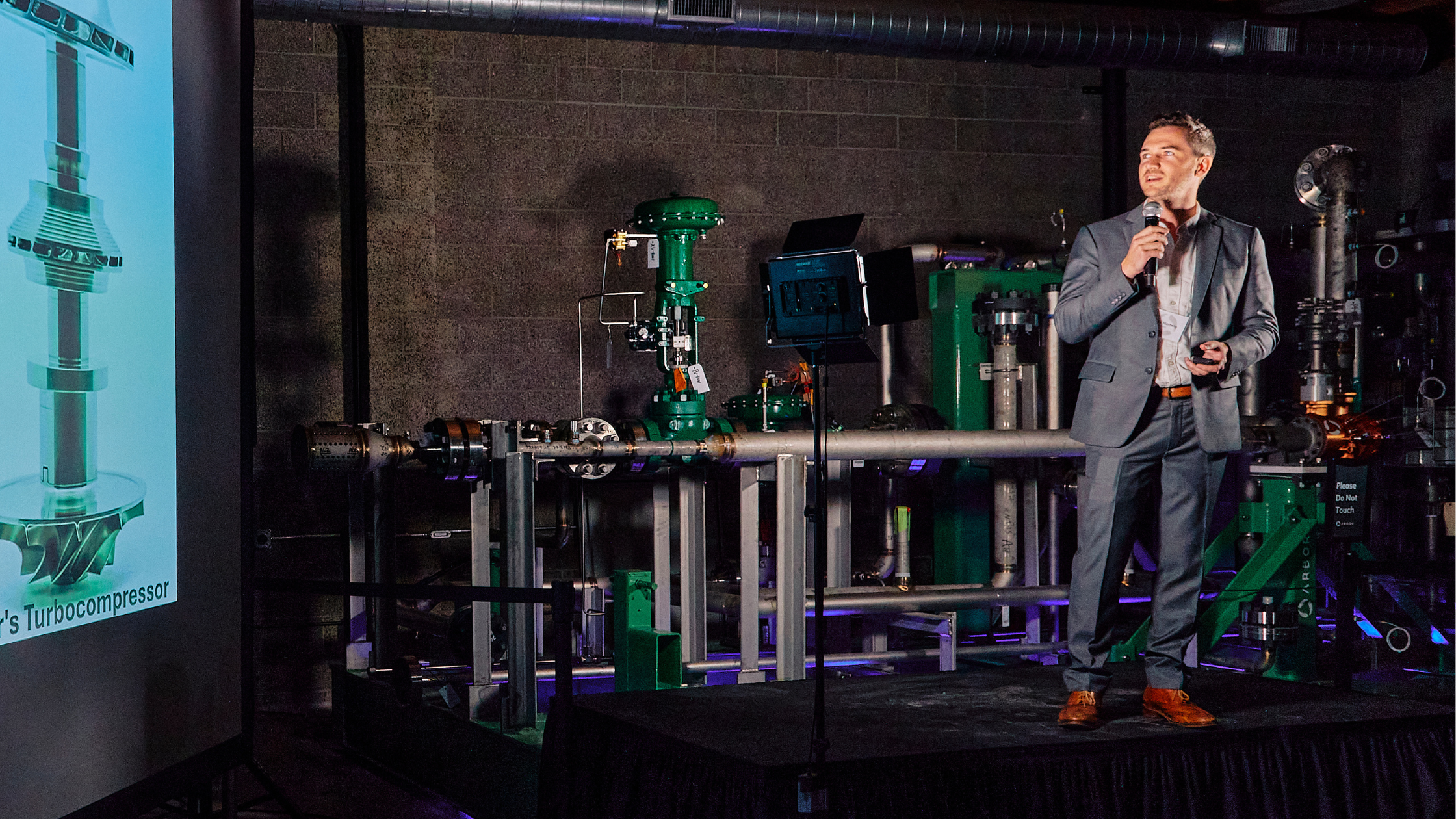
Brad Hartwig, CEO and co-founder of Arbor, is a former SpaceX engineer. He has led the company’s transition from pilot to commercial development. Arbor recently raised a $55-million Series A to support deployment, and said it would use the funding to “complete demonstration of our 1-megawatt [MW] technology pilot ATLAS, while we further the design of HALCYON, our commercial 25-MW supercritical CO₂ [sCO2] power system.” The company said its first HALCYON turbine “is on track to come online by 2028. And by 2030, we aim to manufacture gigawatts’ worth of turbines in support of projects around the world.”
Hartwig recently provided POWER with details about Arbor’s work, and how the company’s turbine system can power future energy projects, including those supporting AI and data centers.